


Page 27 - ISCARs-solutions-for-Heavy-Machining-2022
P. 27
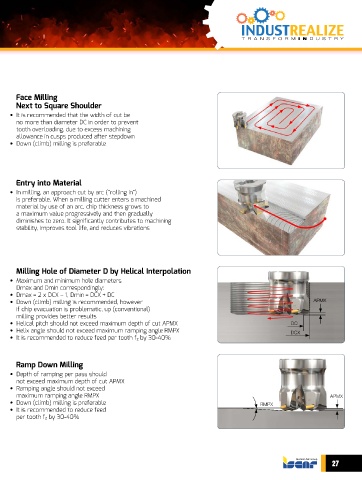
Face Milling
      Next to Square Shoulder
    •  It is recommended that the width of cut be
       no more than diameter DC in order to prevent
       tooth overloading, due to excess machining
       allowance in cusps produced after stepdown
    •  Down (climb) milling is preferable


      Entry into Material

    •  In milling, an approach cut by arc (“rolling in”)
       is preferable. When a milling cutter enters a machined
       material by use of an arc, chip thickness grows to
       a maximum value progressively and then gradually
       diminishes to zero. It significantly contributes to machining
       stability, improves tool life, and reduces vibrations


      Milling Hole of Diameter D by Helical Interpolation
    •  Maximum and minimum hole diameters
       Dmax and Dmin correspondingly:
    •  Dmax = 2 x DCX – 1, Dmin = DCX + DC
    •  Down (climb) milling is recommended, however                                                        APMX
       if chip evacuation is problematic, up (conventional)
       milling provides better results
    •  Helical pitch should not exceed maximum depth of cut APMX                                   DC
    •  Helix angle should not exceed maximum ramping angle RMPX                                    DCX
    •  It is recommended to reduce feed per tooth fz by 30-40%


      Ramp Down Milling
    •  Depth of ramping per pass should
       not exceed maximum depth of cut APMX
    •  Ramping angle should not exceed
       maximum ramping angle RMPX                                                                               APMX
    •  Down (climb) milling is preferable                                                RMPX
    •  It is recommended to reduce feed
       per tooth fz by 30-40%


                                                                                                                 27

