


Page 38 - Demo
P. 38
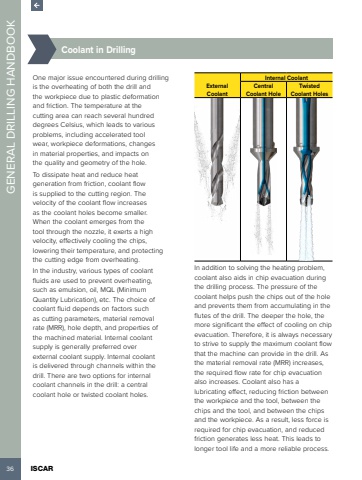
36 ISCAR GENERAL DRILLING HANDBOOK %u00bd%u0009Coolant in DrillingOne major issue encountered during drilling is the overheating of both the drill and the workpiece due to plastic deformation and friction. The temperature at the cutting area can reach several hundred degrees Celsius, which leads to various problems, including accelerated tool wear, workpiece deformations, changes in material properties, and impacts on the quality and geometry of the hole.To dissipate heat and reduce heat generation from friction, coolant flow is supplied to the cutting region. The velocity of the coolant flow increases as the coolant holes become smaller. When the coolant emerges from the tool through the nozzle, it exerts a high velocity, effectively cooling the chips, lowering their temperature, and protecting the cutting edge from overheating.In the industry, various types of coolant fluids are used to prevent overheating, such as emulsion, oil, MQL (Minimum Quantity Lubrication), etc. The choice of coolant fluid depends on factors such as cutting parameters, material removal rate (MRR), hole depth, and properties of the machined material. Internal coolant supply is generally preferred over external coolant supply. Internal coolant is delivered through channels within the drill. There are two options for internal coolant channels in the drill: a central coolant hole or twisted coolant holes.External CoolantInternal CoolantCentral Coolant HoleTwisted Coolant HolesIn addition to solving the heating problem, coolant also aids in chip evacuation during the drilling process. The pressure of the coolant helps push the chips out of the hole and prevents them from accumulating in the flutes of the drill. The deeper the hole, the more significant the effect of cooling on chip evacuation. Therefore, it is always necessary to strive to supply the maximum coolant flow that the machine can provide in the drill. As the material removal rate (MRR) increases, the required flow rate for chip evacuation also increases. Coolant also has a lubricating effect, reducing friction between the workpiece and the tool, between the chips and the tool, and between the chips and the workpiece. As a result, less force is required for chip evacuation, and reduced friction generates less heat. This leads to longer tool life and a more reliable process.


