


Page 13 - Demo
P. 13
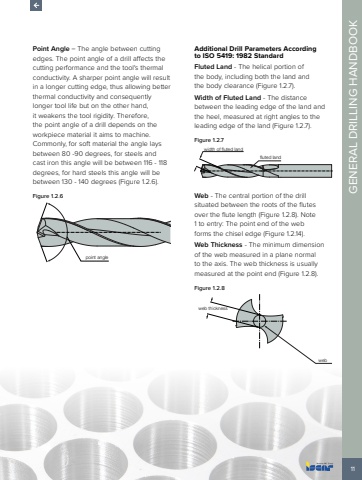
11 GENERAL DRILLING HANDBOOKPoint Angle %u2013 The angle between cutting edges. The point angle of a drill affects the cutting performance and the tool's thermal conductivity. A sharper point angle will result in a longer cutting edge, thus allowing better thermal conductivity and consequently longer tool life but on the other hand, it weakens the tool rigidity. Therefore, the point angle of a drill depends on the workpiece material it aims to machine. Commonly, for soft material the angle lays between 80 -90 degrees, for steels and cast iron this angle will be between 116 - 118 degrees, for hard steels this angle will be between 130 - 140 degrees (Figure 1.2.6).Figure 1.2.6point angleAdditional Drill Parameters According to ISO 5419: 1982 StandardFluted Land - The helical portion of the body, including both the land and the body clearance (Figure 1.2.7).Width of Fluted Land - The distance between the leading edge of the land and the heel, measured at right angles to the leading edge of the land (Figure 1.2.7).Figure 1.2.7width of fluted landfluted landWeb - The central portion of the drill situated between the roots of the flutes over the flute length (Figure 1.2.8). Note 1 to entry: The point end of the web forms the chisel edge (Figure 1.2.14).Web Thickness - The minimum dimension of the web measured in a plane normal to the axis. The web thickness is usually measured at the point end (Figure 1.2.8).Figure 1.2.8web thickness web


